aurumcalendula: gold, blue, orange, and purple shapes on a black background (Default)
AurumCalendula ([personal profile] aurumcalendula) wrote in [community profile] thisfinecrew2026-01-08 12:16 pm

Venezuela

It looks like there were two bills regarding Venezuela introduced yesterday:

H.Con.Res.68 - To direct the removal of United States Armed Forces from hostilities within or against Venezuela that have not been authorized by Congress.

https://www.congress.gov/bill/119th-congress/house-concurrent-resolution/68

and

S.3595 - A bill to prohibit the use of funds for the deployment of United States military or intelligence personnel in Venezuela for certain purposes.

https://www.congress.gov/bill/119th-congress/senate-bill/3595


(I saw the AP mention that a war powers resolution to limit further attacks on Venezuela adanced in the Senate, but I'm unclear if that referred to either of these)
Health | The Atlantic ([syndicated profile] theatlantic_health_feed) wrote2026-01-08 11:14 am

What Having a Fake Disease Taught Me About Health Care

Posted by David H. Freedman

Every few weeks I turn up in a hospital gown at a medical exam room in Massachusetts and describe a set of symptoms that I don’t really have. Students listen to my complaints of stomach pain, a bad cough, severe fatigue, rectal bleeding, shortness of breath, a bum knee, HIV infection, even stab wounds; on one occasion I simply shouted incoherently for several minutes, as if I’d had a stroke. Then the students do their best to help.

I have been given nearly 100 ultrasounds in just the past year, and referred to behavioral counseling dozens of times. I have been consoled for my woes, thanked for my forthrightness, congratulated for my efforts to improve my diet. I have received apologies when they need to lower my gown, press on my abdomen, or touch me with a cold stethoscope. Our encounters, which sometimes run as long as 40 minutes, end with the students giving me their diagnoses; detailing every test, treatment, and drug they want me to have; and then answering all of my questions without ever looking at their watch. Before leaving, they commend me for coming in and promise to check back in on me. It’s a shame I have to feign an illness to get that kind of care.

I learned about fake medical care four years ago when my son, an M.D.-Ph.D. student, mentioned that he was being graded on his skill at treating “standardized patients”: people who are paid to role-play illness. I’m fascinated by the practice of medicine, so I found this notion irresistible. I applied for a job in the standardized-patient program at the University of Massachusetts, and after two full days of training, plus a lot of reading and videos, I was ready to get started.

The practice of faking medical encounters for the sake of education dates back to 1963 at the University of Southern California, but UMass developed one of the first formalized programs in 1982 and has been a model since. Such programs are now, well, standard: According to a count published in a 2023 review of the practice, 187 of the 195 accredited medical schools in the U.S. describe the use of standardized patients on their websites.

Each specific case that an SP might inhabit—and there are hundreds—comes with a minimum of two hours of additional training in person or via Zoom, along with more reading. We’re buried in a blizzard of unique details to memorize about the patients we portray. By the time I’m ready for my fake exam, I can rattle off what vaccinations I’ve had, how long I’ve worked at my job, whether I’ve had my tonsils out, when my mother died, how much weight I’ve gained or lost in recent months, which vitamins I take, how much coffee I drink, how chatty I tend to be, and whether I’ve traveled recently (and might have parasites!).

There’s no script for my encounters, because you never know what the students might ask, say, and do. So I improvise most of my responses, in keeping with the facts I’ve been given. What do I usually eat for breakfast? What do they make at the factory where I work? What sexual acts do my partner and I engage in? My ad-libs are acceptable, according to the grades I get from staff members who occasionally observe the encounters via camera. But many of my colleagues are professional actors, and their performances are superb. We sometimes work in pairs, and more than once I’ve found myself deeply moved—even to the verge of tears—by my partner’s fake suffering.

Of course, we SPs are not the only ones faking it in these sessions; the students are playing along, too. We score them on as many as 50 different elements, including their tone of voice (was it friendly but professional?), their body language (did they lean in to show engagement?), and their facility at palpating our spleens (did they dig in firmly in the right spot?). Most important, we are meant to check that they are learning empathy. Numerous studies have shown that more empathetic care is correlated with better clinical outcomes, perhaps because it makes patients more inclined to share their full medical history, and more likely to stick with whatever treatment has been recommended. In one survey, orthopedic-surgery patients reported that a doctor’s empathy was more central to their satisfaction than the time it took to get an appointment, how long they were stuck in the waiting room, or even what sort of treatment they ended up receiving.

It may not even matter if the doctor’s kindness is sincere, as long as it sounds that way to patients. Dave Hatem, an internist and professor emeritus at UMass who has helped oversee the school’s SP curriculum, told me that even just the act of trying to say empathetic things is valuable for students. “If you get the right words to come out of your mouth, and you do it often enough, then you get to the point where you really mean it,” he said.

Most of the medical students who examine me do seem genuine in their concern. I suspect that if it were up to them, they’d practice medicine this way for the whole of their careers. But however much they might want to provide the superb treatment that I experience as a standardized patient, the health-care system won’t let them.


Elaine Thompson is a recent graduate of Emory University’s medical school, where she learned to provide the same sort of long, thoughtful, whole-person interactions that I get from students. For the past three years, she has been an ear, nose, and throat resident at Johns Hopkins Medicine, one of the best medical centers in the world. Her real-life patient encounters now last for an average of 10 minutes.

“You quickly learn as a resident that the job is to move things along,” Thompson told me. “I’m still curious about my patients as people and want to learn about their families, but if it’s not relevant to their current problem, then asking about it opens a door that will add time to the visit.” So much for chatting to put them at ease, soliciting a full narrative of their symptoms, hearing all their concerns, asking about their job, uncovering anxieties, addressing financial and social challenges, and encouraging their questions. (In an emailed statement, a spokesperson for Johns Hopkins Medicine said that it is committed to delivering “patient-centered training” and “whole person care.”)

[Read: Learning empathy from the dead]

The same is true for Emily Chin, who received her medical degree from UMass in 2023 and is now an ob-gyn resident at UC San Francisco. She told me that she got the message about keeping visits short early on from senior residents, who made a point of tracking the length of her encounters. “I’d just have time to check the cervix, do a quick ultrasound, and then make a decision about admitting or discharging the patient,” she said. Another source of pressure is the knowledge that spending any extra time with a patient means that dozens of other patients will be waiting longer to be seen: “You see the patients piling up in the waiting room, and you see the schedule screen going red.” (UCSF’s vice dean for education, Karen Hauer, did not object to this characterization, but noted that the school advises its residents on how to establish patient rapport when time is short.)

Residents also learn that time is money. Hospitals and practices view a doctor’s interactions with a patient in terms of “revenue value units.” Reimbursement for seeing a patient whose high cholesterol leads to a prescription for a statin might bring $60 into the hospital or clinic. Reimbursement for extra time spent discussing the patient’s fears of side effects and concerns about affording the drug’s co-pay or making dietary changes brings in $0. “That doesn’t exactly encourage providing the most empathetic, patient-centered care,” a UMass Memorial Health resident named Hans Erickson told me.

The residents I spoke with worried that these time pressures were only going to get worse when they finished residency and became full-fledged doctors. In light of those constraints, does it still make sense to emphasize highly empathetic care for students? I asked that question of Melissa Fischer, the physician who directs the SP program and other simulation training at UMass. Fischer argues that the lessons we impart to students can survive the crush of residency, even if they have to be applied in abbreviated ways. “That interest in building connections to patients stays,” she said. “They just have to find faster ways to build them.”

[Read: How to teach doctors empathy]

Lisa Howley, an educational psychologist who serves as the senior director for transforming medical education at the Association of American Medical Colleges, told me that training up a generation of more empathetic medical students will make the health-care system better. “We think of young medical learners as agents of potential change,” she told me. “They’ll see the gaps and weaknesses, and they’ll look for ways to make improvements.” Besides, what would be the benefit of forcing medical students to learn about patient encounters in the hectic, abbreviated format they’ll confront as residents? “It doesn’t make sense to apply those pressures early in their education,” she said. After all, we don’t teach student pilots how to fly a plane while trying to make up for time lost to flight delays or dealing with unruly passengers.

All of the residents I spoke with said they look for ways to connect with patients despite the harsh realities of the system. “The desire to get to know the patient as a whole person doesn’t go away; it’s just a matter of finding ways to bring it to the surface as a stressed resident,” Erickson said. Chin put it this way: “It’s not that it’s challenging to keep up empathy, it’s that it’s hard to be empathetic all the time.”

At the end of my fake encounters, I try to be encouraging. I tell the students how I, as a patient, felt treated by them, and then I challenge them to give ideas for how they might improve. Sometimes, when one of them has done a bang-up job of making me feel heard, I tell them that I hope they’ll be able to sustain that level of engagement when they’re a practicing doctor—and I always get the sense that the students hope so too.

regshoe: (Explaining Alan)
regshoe ([personal profile] regshoe) wrote2026-01-08 04:53 pm

We Lived in Drumfyvie by Margaret Lyford-Pike and Rosemary Sutcliff

Trying something a bit different for the annual Sutcliff this time.

We Lived in Drumfyvie (1975) is a series of short stories about the history of a fictional Scottish town (nothing to do with the real Fyvie in Aberdeenshire, setting of my favourite ballad), from its creation as a burgh by David I in the twelfth century to Victoria's Diamond Jubilee at the end of the nineteenth.

God, it's exhausting being Scottish, in't it? )
Saturday Morning Breakfast Cereal ([syndicated profile] smbc_comics_feed) wrote2026-01-08 11:20 am

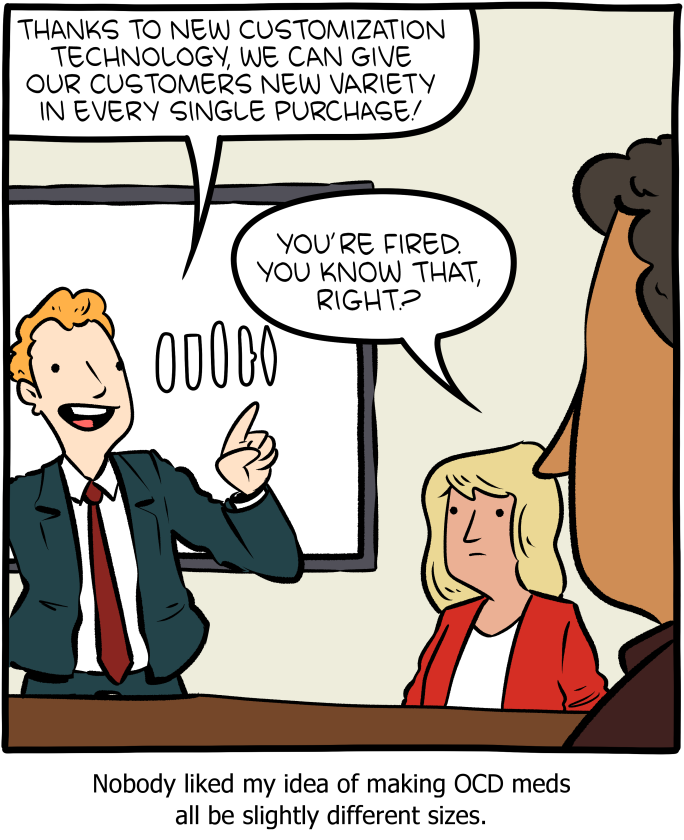
Saturday Morning Breakfast Cereal - Variation

Posted by Zach Weinersmith


Click here to go see the bonus panel!

Hovertext:
And of course the anti-hallucinogenic drugs that sometimes have tiny legs and walk around.


Today's News:
Whatever ([syndicated profile] scalziwhatever_feed) wrote2026-01-08 03:46 pm

Construction Time Again

Posted by John Scalzi

After a delay when the route from the manufacturer to us was literally closed by winter weather, all the components for Krissy’s new garage have arrived and the final construction has begun. One of the advantages of this type of construction is that it’s relatively quick to set up; the should have the whole thing up and insulated in a couple of days, after which time this garage will be the new home of our ride-on lawn mower and Krissy’s dad’s old pick up, which she has kept in meticulous shape and which still runs great.

Obviously I will post when the thing is completed, but I thought this early morning, snapped-when-I-took-the-dog-out shot was a pretty cool in-progress moment. I know Krissy will be happy when her new garage is done, and also, when all the construction mess is gone.

— JS

disneydream06: (Disney Angry)
disneydream06 ([personal profile] disneydream06) wrote2026-01-08 10:01 am
katiedid717: (Default)
katiedid717 ([personal profile] katiedid717) wrote in [community profile] agonyaunt2026-01-08 10:12 am

Ask The Therapist: My Grandchildren Don’t Thank Me for Christmas Gifts. Is This a Moral Failure?

My Grandchildren Don’t Thank Me for Christmas Gifts. Is This a Moral Failure?

My grandchildren are in or nearing their teenage years. Two are from my son and his wife, and two are from my daughter and her husband. Of course, all children love and, to some extent, expect birthday and Christmas gifts. My daughter-in-law and her children continue a tradition of giving me handmade greeting cards every Christmas. They also always send me handwritten thank-you cards for the gifts I send. However, I receive no gifts from my other grandchildren, both boys, and never thank-you cards.

I mentioned this to my daughter, their mother, but there was no response. I suggested that each might give me a card promising 30 minutes of picking up sticks in my yard. I know that gifts should come from the heart with no sense of reciprocity, but the current situation bothers me. There seems to be a lack of moral character being demonstrated, as well as poor ethics and manners.

What do you think?


From the Therapist: You’ve framed your grandsons’ behavior as a case of bad manners or moral failure, but I hear a yearning underneath. No matter how much we tell ourselves that gifts aren’t about reciprocity, the reality is that they often hold emotional significance in which both parties are essentially asking to be recognized. The giver wants acknowledgment of their thoughtfulness and investment, while the receiver wants confirmation that they’ve been truly seen. Both are essentially asking, “Do I matter?”

When we don’t feel seen or appreciated, hurt feelings can disguise themselves as something else, like concern about good character or proper etiquette, because it’s easier to push pain outward than to say, “I feel unimportant to you.” But remember that children take cues from their parents, and I have a feeling that this lack of acknowledgment has more to do with your daughter than with her sons.

For instance, you mentioned that you got no response from her when you brought this up. But instead of telling her what her children should do for you, I’d be curious about why she doesn’t facilitate gift-giving or thank-you-note-writing. I say “she” because most teens don’t do this without some parental prodding, and I imagine that your daughter has her own feelings about your relationship that are being played out in the gifting dynamic.

Maybe gifting between you and her family feels empty or performative, when what she really wants is a different or more meaningful relationship with you. It could be that she perceives you as critical of both her and her sons, demanding of something that she doesn’t feel she or they owe you. She might also find your suggestion that the boys pick up sticks for you as a bit thoughtless: Would it make you happy to ask her children to do something that would feel more like a burdensome chore than something they would actually enjoy giving you?

Meanwhile, you say that your “daughter-in-law and her children” give you cards and write thank-you notes, but I noticed you don’t mention your son. It’s nice that your daughter-in-law has created traditions for her kids around gifting, but this doesn’t mean that her children have stronger characters than your daughter’s children do. It just means that the person your son married facilitates gifting and thanking — and that your son and your daughter don’t.

So what might help? First, separate your hurt feelings from judgments about character. You can feel unappreciated without that meaning that these boys are being raised poorly — or that this is primarily about them. Second, consider what you actually want. Do you want thank-you notes, or do you want to feel more connected to and valued by this branch of the family? If it’s the former, you could issue an ultimatum (no thank-you notes equals no gifts), but I don’t think forced statements of gratitude are what you really want. If you want genuine connection and appreciation, you can start by approaching your daughter with curiosity instead of complaints.
minoanmiss: plus size lady crowned with flowers (Neolithic Summer)
minoanmiss ([personal profile] minoanmiss) wrote in [community profile] agonyaunt2026-01-08 10:05 am

Ask a Manager: Two Tales of Nudity

Well, two tales of skimpy clothing, to compare and contrast.

Read more... )
disneydream06: (Disney Funny)
disneydream06 ([personal profile] disneydream06) wrote2026-01-08 09:05 am

Isn't It Punny.....

Jan. 8th...


Writing with a dull

pencil is pointless.
frith: Realistic My Little Pony Luna and Celestia via generative software (MLP EZ Make Luna and Celestia)
frith ([personal profile] frith) wrote in [community profile] ponyville_trot2026-01-08 09:49 am

Luna Celestia Meteor Shower

Luna_Celestia_Meteor_Shower_via_WaiNSFWIllustriousSDXL_by_Truekry
Source: https://tantabus.ai/images/46261
Pastiche machine generator: Wai_NSFW_Illustrious_SDXL. Prompter: Truekry.

Staying with the shower theme. Bat, rain and now, meteor.
Health | The Atlantic ([syndicated profile] theatlantic_health_feed) wrote2026-01-08 08:00 am

An Underappreciated Variable in Sports Success

Posted by Alex Hutchinson

Chief among the burdens weighing upon the weary sports parent—worse than the endless commutes, the exorbitant fees, the obnoxious parents on the other team—is the sense that your every decision has the power to make or break your child’s future. Should your 11-year-old show up to her elementary-school holiday concert, even if it means missing a practice with the elite soccer team to which you’ve pledged 100 percent attendance? What if this turns out to be the fork in the road that consigns her to the athletic scrap heap?

These are heavy decisions—at least they are for me, a soccer dad who happens to have spent years writing about the science of athletic success. Making it to the pros, the conventional wisdom says, is a consequence of talent and hard work. Best-selling books have bickered over the precise ratio—whether, say, 10,000 hours of practice trumps having the so-called sports gene. But the bottom line is that you need a sufficient combination of both. If you’re talented enough and do the work, you’ll make it. If not—well, decisions (and holiday concerts) have consequences.

Rationally, stressing out over missing a single practice is ridiculous. Believing that it matters, though, can be strangely reassuring, because of the suggestion that the future is under your control. Forecasting athletic careers is an imperfect science: Not every top draft pick pans out; not every star was a top draft pick. Unexpected injuries aside, the imprecision of our predictions is usually seen as a measurement problem. If we could only figure out which factors mattered most—how to quantify talent, which types of practice best develop it—we would be able to plot athletic trajectories with confidence.

Unless, of course, this tidy relationship between cause and effect is an illusion. What if the real prerequisite for athletic stardom is that you have to get lucky?

Joseph Baker, a scientist at the University of Toronto’s Sport Insight Lab, thinks that the way talent development is usually framed leaves out this crucial ingredient. Baker is a prominent figure in the academic world of “optimal human development,” who moonlights as a consultant for organizations such as the Texas Rangers. He’s also a longtime skeptic of the usual stories we tell ourselves about athletic talent. The most prominent is that early performance is the best predictor of later performance. In reality,  many cases of early success just mean an athlete was born in the first months of the year, went through puberty at a young age, or had rich and highly enthusiastic parents.

This critique of talent is not entirely new. It’s been almost two decades since Malcolm Gladwell’s Outliers spurred a cohort of hyper-ambitious soon-to-be parents to begin plotting January birth dates (or at least to tell people they were considering it). Over time, the debate about what factors actually matter has devolved into a game of whack-a-mole. If physical development isn’t the best predictor of long-term success, then it must be reaction time, or visual acuity, or hours of deliberate practice. The default assumption is that there must be something that reveals the presence of future athletic greatness.

Baker’s perspective changed, he told me, when he read Success and Luck, a 2016 book by the former Cornell University economics professor Robert H. Frank. Frank describes a hypothetical sports tournament whose outcome depends 49 percent on talent, 49 percent on effort, and 2 percent on luck. In mathematical simulations where as many as 100,000 competitors are randomly assigned values for each of these traits, it turns out that the winner is rarely the person with the highest combination of talent and effort. Instead, it will be someone who ranks relatively highly on those measures and also gets lucky.

This turns out to be something like a law of nature: It has been replicated and extended by others since Frank’s book came out. Among the most influential models is “Talent Versus Luck,” created by the Italian theoretical physicist Andrea Rapisarda and his colleagues, which simulates career trajectories over dozens of years and reaches the same conclusion. This model earned a 2022 Ig Nobel Prize “for explaining, mathematically, why success most often goes not to the most talented people, but instead to the luckiest.”

To Baker, these models suggest that it’s not just hard to reliably predict athletic futures; it’s impossible. He cites examples including a youth-soccer player for Northampton Town who missed a text message from the team’s manager telling him that he’d been dropped from the roster for an upcoming game. He showed up for the bus, went along for the ride, subbed in when another player got injured, impressed the manager, earned a spot for the rest of the season, and went on to play in the Premier League. Luck takes many forms, such as genetics, family resources, and what sports happen to be popular at a given place at a given time. But sometimes, it’s simply random chance: a gust of wind or an errant bounce or a missed text.

It’s easy to see how luck shapes individual moments in sport—how it changes the course of a game, a series, even an entire season. But what’s harder to accept is that luck might also play a role in longer arcs—not just what happens in games but who appears on the court in the first place. The more you reckon with this, the more disorienting it can be, as things start to feel ever more arbitrary and unfair. As Michael Mauboussin, an investor who writes about luck in his 2012 book, The Success Equation, put it to me: “Talking about luck really quickly spills into the philosophical stuff.”

You might think that the growing professionalization of youth sports offers an escape from this randomness—that by driving to this many practices and paying for that many coaches, you’re ensuring the cream will rise to the top. But the opposite is actually true, according to Mauboussin. In The Success Equation, he describes what he calls the “paradox of skill.” Now that every soccer hopeful is exhaustively trained from a young age, an army of relatively homogeneous talent is vying for the same prizes. “Everyone’s so good that luck becomes more important in determining outcomes,” Mauboussin said.

Baker and one of his colleagues at the University of Toronto, Kathryn Johnston, recently published a paper on the role of luck in athletic development in the journal Sports Medicine–Open. I felt a curious sense of relief when I read it. My daughters, who are 9 and 11, both play competitive soccer on teams requiring a level of commitment that I had naively thought went out of style with the fall of the Soviet Union. Seeing the evidence that future athletic success is not entirely predictable felt like a license for parents to loosen up a bit—to choose the holiday concert over the soccer practice without worrying about the long-term ramifications.

Linda Flanagan, the author of the 2022 book Take Back the Game and a frequent critic of today’s youth-sports culture, doesn’t share my optimism. She has no trouble believing that luck is involved with athletic success, but she doesn’t think that acknowledging this fact will change parental behavior. “Hell, they might double down on the investment in time and money, thinking that they need to give their child more chances to get lucky and impress the right coach,” she told me.

But that sort of luck—getting a job on your hundredth interview because the interviewer went to the same high school as you did, say—arguably is more about hustle than it is about serendipity. So is showing up to every soccer practice. Mauboussin’s definition of luck is narrower: It’s the factors you can’t control. No matter how much luck you try to “create” for yourself or your kids, some irreducible randomness might still make or break you.

To Baker, the takeaways from recognizing the role of luck are less about individual parents and more about how sports are organized. His advice to teams and governing bodies: “If there’s any way possible for you to avoid a selection, don’t select.” Keep as many athletes as you can in the system for as long as you can, and don’t allocate all of your resources to a chosen (and presumably lucky) few. When real-world constraints eventually and inevitably do require you to select—when you’re anointing these lucky few as your future stars, and casting out those who perhaps sang in one too many holiday concerts—try to leave the door open for future decisions and revisions. After all, Baker says, no matter how carefully you’ve weighed your predictions, “you’re probably wrong.”

soemand: (Default)
soemand ([personal profile] soemand) wrote2026-01-08 09:15 am
Entry tags:

Japan

Pics from my trip in 1992–each wooden shingle is a wish for the future.


marcicat: (winter deer)
marciratingsystem ([personal profile] marcicat) wrote2026-01-08 07:26 am

workaday Thursday

Unhelpful or inadvisable things I managed NOT to say at work this week! (Giving myself a gold star and a hug, thx.)

Coworker: 'This is so stressful.'
THING I DIDN'T SAY: 'Have you considered reading fanfiction on your phone to relax?'

***

Coworker: 'This is a list of all the upcoming projects.'
THING I DIDN'T SAY: 'I mean, there's a good chance at least half of them will fail, so that'll really reduce the work load.'

***

Coworker: 'Please review the process I drafted and provide feedback.'
THING I DIDN'T SAY: 'The process is fine, but no one is going to follow it, and there will be no consequences. Are you new here?' (Spoiler: they are new.)

***

Coworker: 'This is Daniel.'
THING I DIDN'T SAY: 'Right, we've met.' (And it's a GOOD THING I didn't say that, because it turned out I've met a DIFFERENT Daniel. Why are there THREE DANIELS at work right now???)
Language Log ([syndicated profile] languagelog_feed) wrote2026-01-08 11:31 am

Chomsky and the origins of AI research

Posted by Mark Liberman

Melissa Heikkilä, "LeCun: 'Intelligence really is about learning'", Financial Times 1/2/2026:

(The AI pioneer on stepping down from Meta, the limits of large language models — and the launch of his new start-up)

LeCun’s lightbulb moment came as a student at the École Supérieure d’Ingénieurs en Électrotechnique et Électronique in Paris in the 1980s, when he read a book about a debate on nature versus nurture between the linguist Noam Chomsky and Jean Piaget, a psychologist. Chomsky argued that humans have an inbuilt capacity for language, while Piaget said there is some structure but most of it is learnt.

“I’m not gonna make friends saying this . . . ” he tells me, “but I was reading this and I thought everything that Chomsky . . . was saying could not possibly be true, [because] we learn everything. Intelligence really is about learning.”

AI research — or neural networks, as the technology was then called, which loosely mimic how the brain functions — was practically a dead field and considered taboo by the scientific community, after early iterations of the technology failed to impress. But LeCun sought out other researchers studying neural networks and found intellectual “soulmates” in the likes of Geoffrey Hinton, then a faculty member at Carnegie Mellon.

[You can't read the whole article at that link without a subscription, which I recommend despite its price. But as Kai von Fintel tells us in the comments, there's an open-access reprint at Ars Technica.]

For a sketch of Yann LeCun's opinions about current directions in AI research, see "AMI not AGI?", 8/2/2025.

And 1980's Yann seems to have fallen into the common error of seeing Noam as a proponent of epistemological nativism rather than rationalism, though Noam has often been misleading on this issue, including apparently in the debate with Piaget. See e.g.

"The Forever War", 2/20/2022
"Straw men and Bee Science", 6/4/2011
"JP versus FHC+CHF versus PU versus HCF", 8/25/2005
"Chomsky testifies in Kansas", 5/6/2005

The book that LeCun refers to is Massimo Piattelli-Palmarini, Ed.,  Language and Learning: The Debate Between Jean Piaget and Noam Chomsky — or presumably the French version Theories Du Language, Theories de L'apprentissage.